Showing posts with label ITU. Show all posts

Sunday, 31 July 2016

International Training Program Concluded in Islamabad

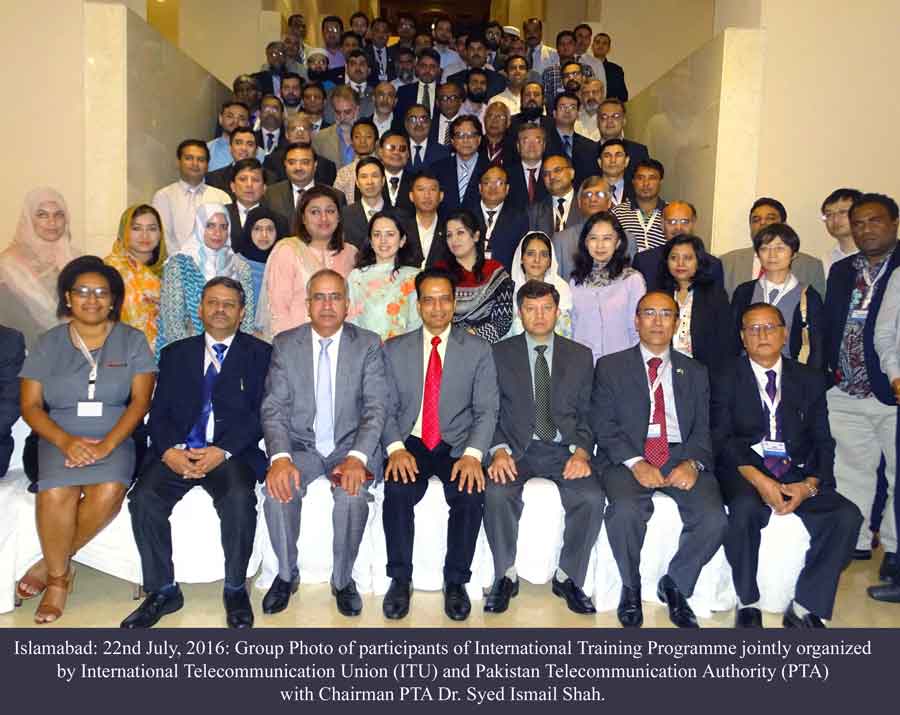
The three days International Training Program (ITP) organized by Pakistan Telecommunication Authority (PTA) in collaboration with International Telecommunication Union (ITU) concluded in Islamabad today.
The program, which ran from 20-22 July, 2016 featured several sessions with national and international speakers.
These sessions focused on new ways and means to address issues and challenges popping up in the ICT sector of the Member States.
Representatives from several countries from Asia Pacific Region including Bhutan, Bangladesh, China, Cambodia, India, Indonesia, Nepal, Maldives, Philippines, Papua New Guinea, Sri Lanka, Samoa, Salomon Island, Timor Leste, Vietnam participated in the event.
Training_PTA
During three days, Director Generals of PTA and senior officials of the telecom operators conducted training sessions on different topics such as biometric verification of SIM users’ data, spectrum management and auction in Pakistan, competition issues in telecom market, online child protection, broadband for networked society, digital financial inclusion and mobile apps, cyber security, consumer protection & quality of Service, OTT players and ICTs for persons with disabilities & women empowerment.
The training covered principles, practices and recommendations which are expected to assist regulators in the Asia-Pacific region in addressing the telecommunication/ICT regulatory challenges.
Mr. Sameer Sharma , Senior Advisor ITU Regional Office for Asia-Pacific said that deliberations through such conferences are helpful in providing international experiences with a focus on current issues and challenges in ICT sector. He said these events have been able to showcase the achievements of Pakistan telecom sector. He appreciated Government of Pakistan for doubling its contribution to ITU. He also thanked PTA for making excellent arrangements for the events.
On this occasion, Chairman PTA Syed Ismail Shah said that this conference was very helpful in highlighting the policy and regulatory issues in the region. He said PTA will continue to host such events in future also to have fruitful discussions. Participants from various countries including Nepal, China, India and Papua New Guinea appreciated hospitality extended to them by the host country.

Pakistan Among Countries With Lowest Internet Penetration: ITU

Pakistan ranks among the countries with lowest internet penetration in the world, indicating that the recent internet uptake during past two years isn’t enough and a lot is still to be done.
Recent most ICT Facts and Figures (2016) released by International Telecommunication Union reveal that Pakistan — with some 18% internet users — is ranked alongside African countries for internet penetration.
Pakistan specific stats reveal that majority of internet users are connected with wireless broadband (3G and 4G) while fixed broadband (DSL, FTTH) still accounts for less than 3% of Pakistan’s population, as compared with 10-12 percent in fixed broadband globally.

World’s Offline Population

ITU emphasized that a 53% of global population, especially in developing worlds, remains cut-off from internet. ITU said that this is happening regardless of the fact that prices for ICT services are falling in almost every market.
More detailed global map of internet penetration in the world is given below:
Global_Internet_Penetration_2016

Global Mobile Broadband Reach

Seven billion people (95% of the global population) live in an area that is covered by a mobile-cellular network (2G at least).
Mobile-broadband networks (3G or above) reach 84% of the global population but only 67% of the rural population.
Advanced mobile-broadband networks (LTE) have spread quickly over the last three years and reach almost four billion people today – corresponding to 53% of the global population.
But while the number of mobile-broadband subscriptions continues to grow at double digit rates in developing countries to reach a penetration rate of close to 41%, mobile-broadband penetration growth has slowed overall.
Globally, the total number of mobile-broadband subscriptions is expected to reach 3.6 billion by end 2016, compared with 3.2 billion at end 2015.
Global_Cellular_Coverage

Fixed broadband growth 

Global fixed-broadband subscriptions are expected to reach around 12 per 100 inhabitants in 2016, with Europe, the Americas and the Commonwealth of Independent States regions having the highest rates of penetration.
Strong growth in China is driving fixed-broadband in Asia and the Pacific, where penetration is expected to surpass 10% by end of 2016.

ICT prices continue to fall

Mobile-broadband services have now become more affordable than fixed-broadband services, with the average price for a basic fixed-broadband plan more than twice as high as the average price of a comparable mobile-broadband plan.
By the end of 2015, 83 developing countries — including Pakistan — had achieved the Broadband Commission’s affordability target.

Digital Divide

By the end of 2016, more than half of the world’s population – 3.9 billion people – will not yet be using the Internet.
While almost one billion households in the world now have Internet access (of which 230 million are in China, 60 million in India and 20 million in the world’s 48 Least Developed Countries), figures for household access reveal the extent of the digital divide, with 84% of households connected in Europe, compared with 15.4% in the African region.
ICT_Prices
Global online gender gap widens
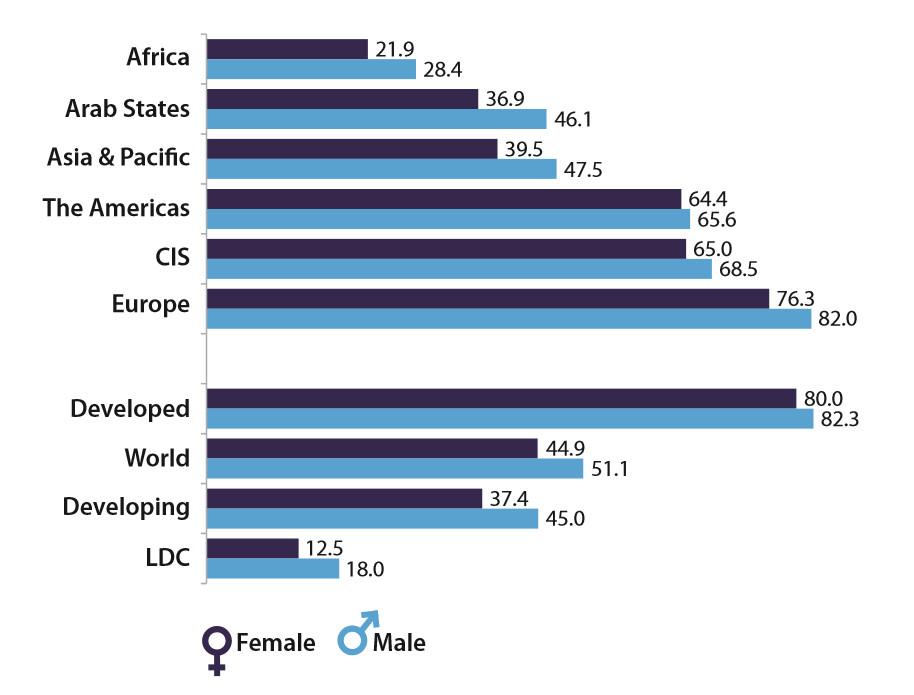
Internet penetration rates are higher for men than for women in all regions of the world.
The global Internet user gender gap grew from 11% in 2013 to 12% in 2016. The regional gender gap is largest in Africa, at 23%, and smallest in the Americas, at 2%.
Digital_Gender_Gap
Internet bandwidth
By early 2016, international Internet bandwidth had reached 185,000 gigabits per second, up from a low of 30,000 gigabits in 2008.
However, bandwidth is unequally distributed globally, and lack of bandwidth remains a major bottleneck to improved Internet connectivity in many developing and Least Developed Countries.
Global_Internet_Speeds

ITU Nominates Anusha Rehman as Commissioner of Broadband Commission

Anusha Rehman, Minister for IT and Telecom, has been nominated by International Telecommunication Union as Commissioner of its “Broadband Commission for Digital Development”, we have checked with Ministry of IT officials.
Broadband Commission is an international body governed under ITU and is meant for the proliferation of broadband in the world.
The Broadband Commission engages in high-level advocacy to promote broadband in developing countries and under-served communities. In doing so, the Commission leverages its high-profile Commissioners to spread the message of Broadband for Sustainable Development at key events, conferences and functions.
Anusha Rehman happens to be first Pakistan to become the commissioner of Broadband Commission.
Other commissioners of Broadband Commission include heads of statea, chairpersons of telecom groups, experts from telecom, academia and other relevant businesses from across the world.
Her selection is primarily the result of work she has done in uptaking the internet penetration in Pakistan.
Anusha’s nomination on this international forum is a recognition of her invaluable services by global community, which she successfully rendered in arena of broadband.
At the time of joining her office in 2013, internet penetration in Pakistan was less than 3 percent which is now hovering around 19 percent. During her tenure Pakistan successfully conducted two spectrum auctions in which four telecom companies were granted 3G licenses while two operators were granted 4G spectrum.