Sunday, 31 July 2016

Pakistan Among Countries With Lowest Internet Penetration: ITU

Pakistan ranks among the countries with lowest internet penetration in the world, indicating that the recent internet uptake during past two years isn’t enough and a lot is still to be done.
Recent most ICT Facts and Figures (2016) released by International Telecommunication Union reveal that Pakistan — with some 18% internet users — is ranked alongside African countries for internet penetration.
Pakistan specific stats reveal that majority of internet users are connected with wireless broadband (3G and 4G) while fixed broadband (DSL, FTTH) still accounts for less than 3% of Pakistan’s population, as compared with 10-12 percent in fixed broadband globally.

World’s Offline Population

ITU emphasized that a 53% of global population, especially in developing worlds, remains cut-off from internet. ITU said that this is happening regardless of the fact that prices for ICT services are falling in almost every market.
More detailed global map of internet penetration in the world is given below:
Global_Internet_Penetration_2016

Global Mobile Broadband Reach

Seven billion people (95% of the global population) live in an area that is covered by a mobile-cellular network (2G at least).
Mobile-broadband networks (3G or above) reach 84% of the global population but only 67% of the rural population.
Advanced mobile-broadband networks (LTE) have spread quickly over the last three years and reach almost four billion people today – corresponding to 53% of the global population.
But while the number of mobile-broadband subscriptions continues to grow at double digit rates in developing countries to reach a penetration rate of close to 41%, mobile-broadband penetration growth has slowed overall.
Globally, the total number of mobile-broadband subscriptions is expected to reach 3.6 billion by end 2016, compared with 3.2 billion at end 2015.
Global_Cellular_Coverage

Fixed broadband growth 

Global fixed-broadband subscriptions are expected to reach around 12 per 100 inhabitants in 2016, with Europe, the Americas and the Commonwealth of Independent States regions having the highest rates of penetration.
Strong growth in China is driving fixed-broadband in Asia and the Pacific, where penetration is expected to surpass 10% by end of 2016.

ICT prices continue to fall

Mobile-broadband services have now become more affordable than fixed-broadband services, with the average price for a basic fixed-broadband plan more than twice as high as the average price of a comparable mobile-broadband plan.
By the end of 2015, 83 developing countries — including Pakistan — had achieved the Broadband Commission’s affordability target.

Digital Divide

By the end of 2016, more than half of the world’s population – 3.9 billion people – will not yet be using the Internet.
While almost one billion households in the world now have Internet access (of which 230 million are in China, 60 million in India and 20 million in the world’s 48 Least Developed Countries), figures for household access reveal the extent of the digital divide, with 84% of households connected in Europe, compared with 15.4% in the African region.
ICT_Prices
Global online gender gap widens
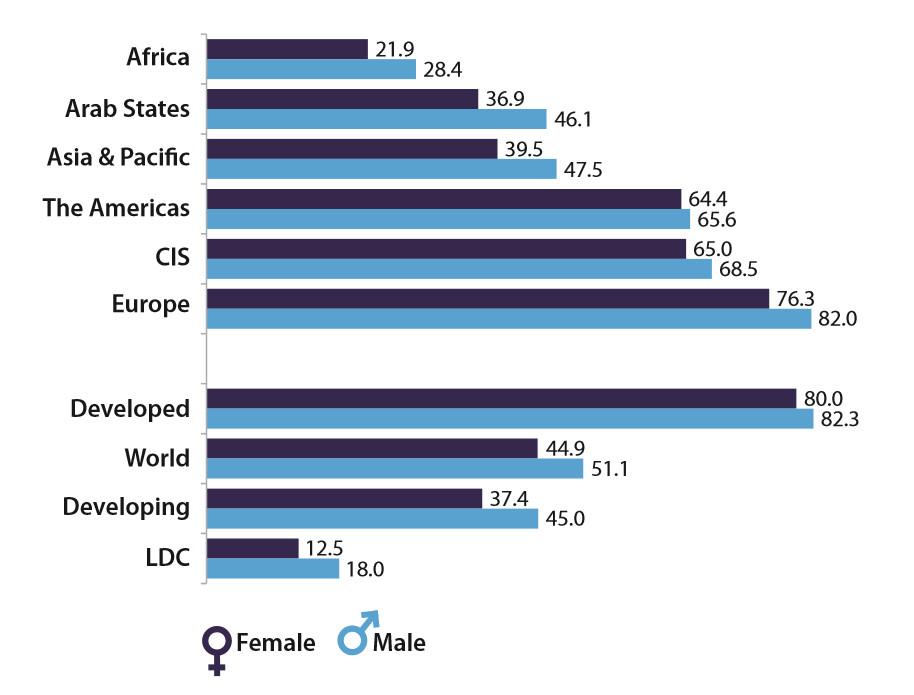
Internet penetration rates are higher for men than for women in all regions of the world.
The global Internet user gender gap grew from 11% in 2013 to 12% in 2016. The regional gender gap is largest in Africa, at 23%, and smallest in the Americas, at 2%.
Digital_Gender_Gap
Internet bandwidth
By early 2016, international Internet bandwidth had reached 185,000 gigabits per second, up from a low of 30,000 gigabits in 2008.
However, bandwidth is unequally distributed globally, and lack of bandwidth remains a major bottleneck to improved Internet connectivity in many developing and Least Developed Countries.
Global_Internet_Speeds

ITU Nominates Anusha Rehman as Commissioner of Broadband Commission

Anusha Rehman, Minister for IT and Telecom, has been nominated by International Telecommunication Union as Commissioner of its “Broadband Commission for Digital Development”, we have checked with Ministry of IT officials.
Broadband Commission is an international body governed under ITU and is meant for the proliferation of broadband in the world.
The Broadband Commission engages in high-level advocacy to promote broadband in developing countries and under-served communities. In doing so, the Commission leverages its high-profile Commissioners to spread the message of Broadband for Sustainable Development at key events, conferences and functions.
Anusha Rehman happens to be first Pakistan to become the commissioner of Broadband Commission.
Other commissioners of Broadband Commission include heads of statea, chairpersons of telecom groups, experts from telecom, academia and other relevant businesses from across the world.
Her selection is primarily the result of work she has done in uptaking the internet penetration in Pakistan.
Anusha’s nomination on this international forum is a recognition of her invaluable services by global community, which she successfully rendered in arena of broadband.
At the time of joining her office in 2013, internet penetration in Pakistan was less than 3 percent which is now hovering around 19 percent. During her tenure Pakistan successfully conducted two spectrum auctions in which four telecom companies were granted 3G licenses while two operators were granted 4G spectrum.

Huawei Sales Increase by 40% in First Half of 2016

Huawei is looking set to join the big leagues in the smartphone business. The company has announced its revenue figures for the first half of 2016 and they are already 40-percent higher than what they were a year ago, reaching $36.8 billion.
The number outranks the growth margin of 30 percent which Huawei experienced over the same duration a year before. It hasn’t announced how many smartphones or accessories it sold during this half but it could be a sizeable gap over the 48.2 million phones it shipped in H1 2015.
It has already recorded shipments of more than 28 million in Q1 of 2016 already. With sales for the new P9 and P9 Plus flagships still going fairly strong, the company is likely seeing a sizeable increase in demand.
A concern which the Chinese company could face in the future are the declining operating margins. Over the same time past year, they declined 6-percent to just 12 percent for H1 2016, something which could likely be attributed to an increased focus towards smartphones.
We are confident that Huawei will maintain its current momentum, and round out the full year in a positive financial position backed by sound ongoing operations. – Huawei CFO Sabrina Meng
The strong statistics mean Huawei is on course to meet its target of reaching $75 billion in revenues for the year, its highest ever.
Last year, Huawei became the first Chinese manufacturer to record 100 million units in sales. With increasing revenues, it is looking well on course to become the third biggest smartphone company there is.

PTA Organizes Pakistan ICT Indicators Symposium

Pakistan Telecommunication Authority (PTA),Ministry of Information Technology & Telecom (MoIT) and International Telecommunication Union (ITU) jointly organized ‘Pakistan ICT Indicators Symposium’ under the theme of ”Multi-stakeholder Engagement to Highlight the need of ICT Data Reporting” at PTA Headquarters today.
The Chief Guest of the event was Ms. Anusha Rehman Khan, Minister of State for Information Technology & Telecommunications (MOIT&T) and Mr. Rizwan Bashir Khan, Secretary, MOIT, was the guest of honor. Chairman PTA, Dr. Syed Ismail Shah, Mr. Tahir Mushtaq, Member (HRD), MoIT, Mr. Sameer Sharma, Senior Advisor, ITU Asia-Pacific. Mr. Tariq Sultan, Member (Finance) Mr. Abdul Samad, Member (Compliance & Enforcement) PTA were present on this occasion. Representatives from MOIT&T, Pakistan Bureau of Statistics (PBS), Telecom Operators, international organizations, donor agencies, DGs of different Divisions of PTA and senior officers of the Authority attended the event.
On this occasion, Ms. Anusha Rehman Khan said that ICTs indicators are related to newly formulated Sustainable Development Goals. Since we all know that SDGs of the United Nations (UN) represent a renewed commitment of the 193 country leaders to ending poverty, combat hunger, and disease, and promote social justice and human dignity. She said that it is imperative to mention that ICT indicators are the key enablers to achieve multiple SDGs. ICT indicators can also help monitor achievements in other areas included in the SDGs, such as poverty reduction, education and economic growth.  We all need to take a proactive approach to develop a comprehensive mechanism to collect all relevant ICT data. The Minister said that Pakistan has shown tremendous growth in telecom sector over the last few years and it has also achieved some exceptional milestones. Similarly, on the policy front, finalization and approval of a comprehensive Telecommunication Policy is yet another milestone achieved, she further added.
Earlier, addressing the event Secretary, MOIT said that the Government is committed to enhance the quality of manpower in the ICT sector. We will continue to provide the necessary support to the industry. He said that we need the effort and close cooperation from all of us including operators, equipment manufacturers and content providers for the contribution of ICT sector in GDP. He appreciated the efforts of PTA towards proliferation of ICT sector of the country. He further said that local content and applications have generated new forms of consumption and attracted large number of consumers.
Chairman PTA said in his welcome address that to take advantage of the rapidly changing society, governments need to monitor and benchmark progress in order to design and review national policies and strategies. In order to do so, reliable data and indicators on the access and use of ICTs, and their impact on development have to be defined and collected. Chairman said that such data and indicators help governments design and evaluate ICT policies and strategies, compare their ICT developments with those in other countries and adopt solutions to reduce the digital divide. These rankings also depicts the current snapshot of country’s ICT profile that is a key parameter for investors to analyze market and to take an informed decision of their investment opportunity in the country, Chairman further added.
PTA_PHOTO1
At the symposium, Mr. Tahir Mushtaq, Member (HRD), MoIT highlighted Ministry of IT role in the betterment of ICT Indicators.  Mr. Sameer Sharma Senior Advisor, ITU Asia-Pacific  introduced ITU’s work on ICT indicators measurement.
Mr. Tariq Sultan Member (Finance), PTA briefed about PTA efforts for improving the ICT profile of Pakistan. Dr. Muhammad Saleem, DG, PTA shared his views on telecom data collection  by PTA, Ms. Rabia Awan, Director, PBS  and, Mr. Attiq-ur Rehman, Director, PBS, gave presentations on ICT household data collection by PBS, and Mr. Zafar ul Hassan, Project Director, Ministry of Planning, shared about development and reform ICT indicators & effective monitoring of  SDGs.
Mr. Abdul Samad, Member (Compliance & Enforcement), PTA moderated a session under the theme “removing impediments on ICT data collection & way forward. Mr. Arif Sargana, Director (CA), PTA , Mr. Syed Ali Abbas Hasani, Director, PSEB, and Mr. Sikander Naqi representative from CMOs also shared their views on  removing impediments on ICT data collection & way forward. Further the symposium provided opportunities to the stakeholders such as ITU, PBS, MOIT&T to shared their perspective and opinions on improving ICTs data collection and reflecting true picture of the progress in telecom sector of the country. At the end of symposium Chief Guest presented shields to the speakers.
It may be mentioned that State Minister for IT&T, Ms. Anusha Rehman Khan, has been appointed by ITU Secretary General as Broadband Commissioner for sustainable development of international Telecommunication Union (ITU). ITU and UNESCO set up the Broadband Commission for Digital Development in response to UN Secretary-General Ban Ki-Moon’s call to step-up UN efforts to meet the Millennium Development Goals (MDGs).

Careem Offers Telenor Users a First-Time 35% Discount and Free WiFi

Careem and Telenor have partnered to provide discounted fares to customers who use Telenor’s service. Careem is a transportation company quite similar to a cab service which connects the captains (drivers) with the customers via its app.

Details about the Offer

The transportation service will be giving a discount of 35% to Telenor customers for their first ride using Careem. Furthermore, all customers will now have access to free wifi during the ride. The captains will also be able to avail special data packages from Telenor.
The discount will be available from 26th July till 9th August for business and economy users both for their first ride only. You can use the promotional code Telenor35 to avail the discount while booking a ride.
Careem operates in Karachi, Lahore and Islamabad. Internationally Careem operates in the UAE and Saudi Arabia as well. Careem’s service is different from regular cab services in that it offers an app for its customers in addition to hailing a cab via a call.

Telenor and Careem Partnership

Telenor Pakistan’s CEO Michael Foley added,
With Careem, Telenor subscribers will not only enjoy cheaper and more comfortable rides, but also WIFI connectivity on the go. We will continue to look for newer avenues of serving our valued customers.
Managing Director of Careem Junaid Iqbal also commented on this new partnership saying that they are happy with this crucial deal with Telenor. He said that the agreement between Telenor Pakistan and Careem will help them explore newer prospects for them to further accommodate their customers, and that they will explore more options on expanding upon this agreement and their joint venture in general.

Watch Out: These CCTV Cameras Can Steal Your ATM Pins

Cameras are placed on all ATMs now for security reasons. But sometimes the same camera can prove to be a security risk itself. Wondering how? Let’s have a look:
On a UBL ATM in Centaurus, Islamabad, a CCTV camera is placed at such a point where the ATM keypad is clearly visible. When an ATM user punches the keys for entering their pin code, it is seen in pictures. Now any person with malicious intent in the bank watching the CCTV footage can notice a user’s pin code and do with it as they please.
Not to mention that if the CCTV stream is hacked somehow, the users are easy prey for hackers.
1
This becomes a big question mark on the security of users’ accounts, though it may be a co-incidence. But that’s besides the point since it is not at all acceptable. This is a security, privacy, and rules breach by the respective bank itself. Certain questions arise regarding this act of sheer negligence:
Is it in the notice of respective bank branch? It must be! As the CCTV footage is pretty clear. So has the branch manager or administration taken any step to remove the camera from that particular point?
Is it done intentionally by any malevolent bank employee or the camera installing person? Has the bank admin done any investigation?
Is there any theft or misuse of a user’s account reported to the bank administration? If yes, have they taken any step?
Has the bank branch placed a notice there for users to operate the keypad secretively till the camera position is changed?
Is this an isolated instance or do such cameras exist at other ATMs as well?
2
A few weeks ago, another financial and banking scam came to surface. Some people fixed a sort of secret scanner into the ATMs where the card is inserted. It was used to read the data from ATM card and the robbers made transactions from many accounts. That way, tens of thousands of rupees were looted.
If a bank fails in such basic security, it loses credibility. And once that happens, people will be hesitant to trust banks with their cash. In fact, such a security breach can lead people to sue the bank because none other than the bank management can be held responsible for such negligence. People don’t tolerate carelessness regards to money that too in the supposed safe hands of bank.
After the coming to light of this security breach, other banks and their users will also get watchful. To stay safe, a simple precaution can save customers from such a theft which is almost impossible to trace. Now almost all the ATMs have biometric devices. Users should start operating the ATMs through biometric instead of pin code. This is the easiest and safest way to use any ATM.
3
Also the users should report this negligence to the respective bank branch immediately, be aware while using any ATM, and operate keypad secretively. Carefulness is the only solution.

Affordable Xiaomi Redmi Pro Offers an OLED Display & Dual Camera Setup

Chinese smartphone giant Xiaomi has just revealed the Redmi Pro, its flagship device for 2016.
Known to make affordable smartphones with top notch features, Xiaomi is a popular brand across the world, including Pakistan (however these devices are officially banned by PTA as per media reports).
Redmi series from Xiaomi is aimed at budget conscious smartphone customers who want to get “big” smartphones and top features without spending much.
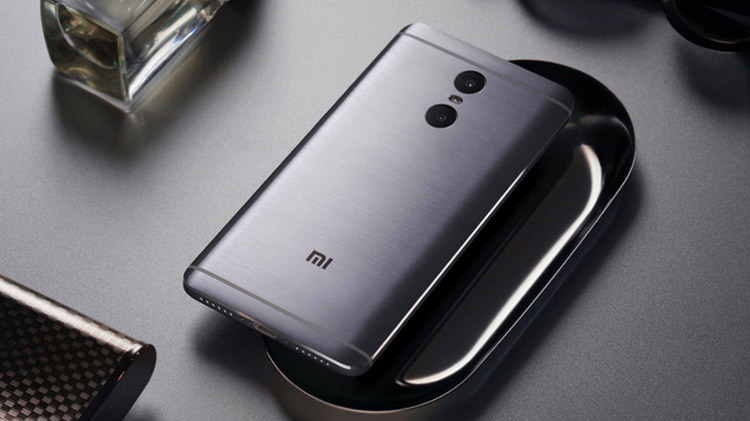
The main highlight of Redmi Pro is the “Dual Camera” consisting of a 13 MP Sony IMX 258 sensor and secondary 5MP Samsung camera, which actually gives you control over depth of field or simply the bokeh effect in your pictures.
camera-redmi-pro
Redmi Pro comes with a brushed aluminum body and a 2.5D curved front featuring a 5.5 FHD display with OLED panel, for brighter colors and rich contrast.
On the inside, this phone is packed with Helio X25 10-Core Processor with clock speeds up to 2.5 GHz and Mali – T880 GPU. To support the high performance CPU, there is a duo of 4GB RAM and 128GB built in storage. You can also use an SD card to expand storage.
This phone packs a dual-SIM hybrid slot and does support VoLTE, along with other connectivity features such as 4G LTE, Bluetooth, GPS, and Wi-Fi 802.11ac.
The specs card also includes a finger print scanner on the front, USB Type-C port and a 4050mAh battery. There is no official word on quick charge, but it must be there. The phones also gives you control over TVs and other home appliances via IR Blaster.
redmi-pro-press
On the software side, the Redmi Pro runs Android 6.0.1 Marshmallow wrapped under Xiaomi’s custom MIUI 8.
This phone will be available in three colors; Gold, Silver, Dark Grey. The price for 3GB/32GB version is $224 (Rs. 24,000), for 3GB/64GB is $255 (Rs. 27,000) and for 4GB/128GB is $300 (Rs. 32,000).
The Chinese manufacturer claims it has sold over 110 million Redmi phones around the world as of July 2016. Xiaomi might not get the green light to start sales in Pakistan anytime soon, but we can expect that in couple of couple of months Redmi Pro will be available in the Pakistan market (unofficially), but with a higher price tag.